


The Mergui Archipelago remains one of Southeast Asia’s last true marine frontiers. A vast constellation of 99 islands, many still largely uncharted and unexplored. My work there began in 2018 at Kyun Pila, an island west of Lampi National Park, where we initiated a multi-pronged conservation strategy focused on coral propagation, ghost net retrieval, and the cataloging of marine and terrestrial flora and fauna. Between 2018 and the onset of the Covid-19 pandemic in early 2020, the team completed a monumental scientific transect across the island, spanning more than 7 kilometers on land and 21 kilometers through aquatic environments. The expedition revealed not only the immense ecological richness of the archipelago, but also the urgency of safeguarding one of the Indian Ocean’s most fragile and least understood ecosystems.

The Mergui Archipelago, located in the remote Andaman Sea of southern Myanmar, is one of Southeast Asia’s last largely unexplored marine wilderness regions, consisting of hundreds of tropical islands surrounded by rich coral reefs, seagrass beds, and pelagic waters. Known for its exceptional biodiversity, dramatic underwater landscapes, and isolated ecosystems, the region supports reef sharks, manta rays, sea turtles, and extensive hard coral communities. My work in Mergui focuses on marine exploration, reef assessment, biodiversity documentation, and promoting sustainable conservation practices in remote reef environments. Through field expeditions and ecological observations, the project highlights the importance of protecting one of the Indo-Pacific’s remaining frontier marine ecosystems while advancing awareness of responsible marine stewardship and reef rehabilitation.
MERGUI ARCHIPELAGO

Kyun Pila
In the far reaches of the Mergui Archipelago, where the Andaman Sea still moves to rhythms largely untouched by time, lies Kyun Pila—an island that feels less like a destination and more like a quiet revelation. Stretching seven kilometers in length and four at its widest embrace, the island unfolds in a gentle sequence of white-sand beaches, dense coastal forest, and tidal mangroves that breathe with the ocean itself. Here, the boundary between land and sea dissolves into something softer, something more ancient.
At the heart of Kyun Pila stands Awei Pila Resort, a thoughtful presence shaped by Memories Group. Rather than imposing itself upon the island, the resort seems to listen—to the tides, the wind through the casuarina trees, the quiet footfalls of wildlife emerging at dusk. It is a place where luxury does not compete with nature, but instead frames it, allowing visitors to rediscover a slower, more attentive way of being. Mornings arrive with soft light over glassy water; evenings dissolve into a horizon of amber and violet, where the only soundtrack is the sea. Yet Kyun Pila is not defined by its shores alone. Just beyond its horizon lies the protected wilderness of Lampi National Park, a sanctuary of extraordinary ecological richness and Myanmar’s only marine national park. This is a landscape where coral reefs thrive beneath clear waters, where seagrass meadows shelter dugongs, and where mangrove forests serve as nurseries for countless marine species. The park is also home to the Moken people, whose deep, ancestral relationship with the sea offers a living testament to coexistence rather than control.
Together, Kyun Pila and Lampi National Park tell a story that is becoming increasingly rare in our world—a story of balance. It is a place where ecosystems still function with integrity, where forests filter into reefs, and where human presence, when guided by respect, can exist without eroding what makes the place extraordinary.
To step onto Kyun Pila is to be reminded that not all frontiers are meant to be conquered. Some are meant to be understood, protected, and quietly experienced. In this corner of Myanmar, the ocean still teaches, the forest still shelters, and the horizon still invites. Not with urgency, but with a calm, enduring promise.


THE MOKEN
Along the scattered islands of the Mergui Archipelago lives one of Southeast Asia’s most remarkable maritime cultures. The Moken, often called “sea nomads.” For generations, they have belonged not to any single island, but to the entire seascape itself, moving with the seasons across the Andaman Sea in rhythm with winds, tides, and marine life.
Traditionally, the Moken lived much of their lives aboard hand-built wooden boats known as kabang. These vessels were more than transport. They were homes, tools of survival, and symbols of identity. Entire families would travel between islands, fishing with spears and hand lines, gathering shellfish, and free-diving with extraordinary skill. Moken children, in particular, are known for their ability to see clearly underwater, an adaptation developed through years of daily interaction with the sea.
Their relationship with the ocean is not simply practical, it is deeply spiritual. The Moken worldview sees the sea as a living entity, governed by spirits and ancestral forces. Natural events, from storms to tides, are understood through this lens, shaping a culture rooted in respect rather than control. Oral traditions, songs, and rituals carry knowledge of navigation, weather, and survival, passed down through generations without written language.
During the monsoon season, when the sea becomes unpredictable, the Moken retreat to temporary settlements on sheltered islands. These stilted villages, lightly built and often transient, reflect a way of life designed to leave minimal trace on the land. In places near Lampi National Park, some communities still maintain this seasonal rhythm, balancing movement with moments of rest.
Yet today, the Moken way of life stands at a fragile crossroads. Increasing regulation of marine territories, pressures from tourism, and the draw of settled life have begun to alter their nomadic traditions. Many Moken now live more permanently in coastal villages, with younger generations gradually losing the intimate knowledge of the sea that once defined them.
Still, in the quieter corners of the archipelago, echoes of the old life remain. A kabang drifting at sunrise, a child diving effortlessly beneath the surface, a community gathering at the edge of the tide. These are not just images, but fragments of a living heritage. The Moken remind us that the ocean is not merely a resource, but a home, and that true understanding of nature comes not from mastering it, but from moving within it with humility.


TRANS-ISLAND TRANSECT
On Kyun Pila conservation did not begin with grand infrastructure or sweeping declarations. It began with footsteps. A single line drawn across the island five kilometers from one shore to the other. It became the foundation of understanding. This was the Trans-Island Transect: a living pathway carved through dense coastal forest, winding into the breathing labyrinth of mangroves, and emerging again where land meets sea. It was not simply a trail, but a commitment. To observe, to listen, and to learn from the island on its own terms.


Between 2018 and 2019, a small team of eight volunteers gave themselves to this quiet mission. There were no shortcuts, no easy days. Each morning began with the weight of humidity and the promise of discovery. Equipment was checked, boots laced, and the transect entered once more. Not as conquerors, but as guests moving carefully through a complex, living system. Camera traps were set along animal pathways, silently waiting to reveal the unseen lives of the forest. Birds were cataloged by both sight and sound, their calls becoming familiar markers of time and territory. Plants were recorded with patience and precision, leaf by leaf, root by root. Building a growing archive of the island’s botanical identity. And always, there was maintenance of the trail itself, a constant negotiation with nature as roots reclaimed the ground and vines reached back across the path.
What emerged was more than data. It was a relationship. The forest began to speak in patterns. Certain calls at dawn, particular movements at dusk. The subtle shift of species between the dry and wet cycles. The quiet presence of life that would have gone unnoticed without repetition, without commitment. By walking the same path again and again, the team did not just document Kyun Pila, they began to understand it.


Then, as the world paused with the arrival of COVID-19, so too did the footsteps along the transect. The trail, once marked by daily passage, was left to the island once more. Leaves fell, branches shifted, and the forest gently reclaimed its space. But the work was not lost. Every record, every observation, every shared moment had already taken root in something larger. A long-term vision of stewardship grounded in knowledge. The Trans-Island Transect stands as a reminder that conservation is not always dramatic. Sometimes, it is the discipline of returning. The humility of walking the same ground, day after day, until the unfamiliar becomes understood, and the unseen becomes known. On Kyun Pila, those seven kilometers are more than distance. They are a bridge between people and place, between curiosity and care, and between the present moment and the future we choose to protect.


THE MANGROVES
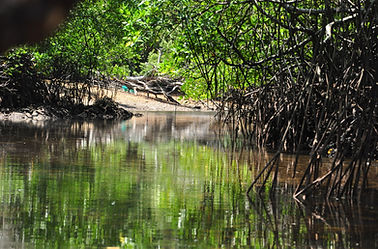
There are mangroves, and then there is Kyun Pila. In much of Southeast Asia, mangrove forests carry the marks of pressure. Sediment, pollution, fragmentation. But on Kyun Pila, in the remote reaches of the Mergui Archipelago, the mangrove ecosystem exists in a state that feels almost improbable. The water is not the usual murky brown, but startlingly clear, revealing a submerged world in motion, roots descending like sculptures into glass, fish weaving effortlessly between them, and the quiet pulse of life at every level.
Here, the mangroves are not just surviving, they are thriving. Towering stands of trees anchor themselves into soft sediment, their root systems forming intricate networks that stabilize the coastline while nurturing an entire ecosystem beneath. Juvenile fish shelter among the tangled roots, crustaceans move with the tides, and birdlife animates the canopy above. Every layer is connected, every movement part of a larger, uninterrupted system. What makes Kyun Pila exceptional is not only its biodiversity, but its integrity. This is an undisturbed habitat. One that has not been fragmented, dredged, or reshaped to fit human convenience. The water flows as it should. The tides breathe in and out without obstruction. Life here follows patterns that have remained intact for generations.
There is a clarity to the experience that goes beyond the water itself. Standing at the edge of these mangroves, or drifting silently through them, you begin to understand their true role, not as marginal landscapes, but as engines of life. They are nurseries for the sea, guardians of the shoreline, and quiet reservoirs of resilience. In Kyun Pila, the mangroves do not ask to be admired. They simply exist, complete and undisturbed. And in that rare completeness, they offer something increasingly scarce. A glimpse of what nature looks like when it is allowed to function exactly as it was meant to.


WILDLIFE
Along the length of the Trans-Island Transect on Kyun Pila, the trail quietly opens into a series of wildlife observation stations. Places chosen not for convenience, but for signs of life. A bend in the path where tracks converge, a clearing marked by fallen fruit, the edge of a mangrove channel where land and tide intersect. These are the points where the forest reveals itself, if you are patient enough to wait. Here, stakeouts become a discipline of stillness. Hours pass in near silence, broken only by the shifting of leaves or the distant call of birds. The work is not to search, but to allow the forest to come to you. In these moments, time slows, and the senses sharpen. Every movement, every sound carrying meaning. Camera traps extend this vigilance into the hours when humans are absent. Positioned along animal trails and feeding grounds, they become silent witnesses to a hidden world. At night, when the transect is empty, the forest comes alive in ways rarely seen—nocturnal mammals moving through the undergrowth, cautious and deliberate, unaware of the small, watching lens. Each captured image is more than documentation; it is proof of presence, a fragment of a story that would otherwise remain untold.
These observation stations are not intrusive structures, but subtle interventions designed to blend into the environment, to observe without altering behavior. Over time, patterns begin to emerge. Certain species favor specific crossings. Activity shifts with the tide in the mangroves. The forest, once unpredictable, begins to reveal its rhythms. What unfolds along these stations is a deeper understanding of coexistence. You begin to realize that wildlife is always there, moving just beyond the edge of perception. It is not absence that defines the forest, but our inability to see without patience.
On Kyun Pila, these quiet outposts transform the transect into something more than a trail. They turn it into a living archive, one that records not only species, but behavior, movement, and the subtle balance of an undisturbed ecosystem. And in doing so, they remind us that the act of watching, when done with respect, is one of the most powerful tools conservation has.


ORNITHOLOGY
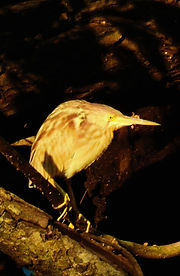
Along the transect and beyond it, into the forest canopy and out to the quiet edges of Kyun Pila’s beaches some members of the team took on a different kind of patience. Their focus was not on footprints or motion-triggered frames, but on wings, light, and fleeting moments. They carried long lenses and even longer hours. Before dawn, they would already be in position, hidden among roots, behind driftwood, or beneath the cover of low branches waiting for the first movement in the half-light. The work demanded stillness, but also intuition: knowing where a bird might land, how it might move, how long it might stay.
In the forest, the air would come alive with calls before the birds themselves were visible. A flash of color through dense foliage, a sudden shift in the canopy, a brief silhouette against the morning sky. These were the moments they trained themselves to anticipate. Native species, familiar yet never predictable, revealed themselves slowly, rewarding those who returned again and again to the same quiet corners.
Along the beaches, the rhythm changed. Migratory birds arrived with the tides, resting and feeding along the shoreline, their journeys spanning continents. Here, the challenge was distance and light approaching without disturbance, reading the wind, and waiting for that precise alignment when bird, sea, and sky come together in a single frame. Days would pass like this, measured not in hours but in encounters. Many ended without a single photograph worth keeping. But that was never the point. The act of waiting, of observing without intrusion, was itself part of the process—an immersion into the tempo of the island.
And then, sometimes, everything aligned. A bird perched just long enough. A wing caught in perfect light. A behavior documented that added a new layer to understanding. These images became more than photographs; they became records of presence, of migration, of life moving through Kyun Pila as it has for generations. In the end, those assigned to photograph the birds were not just capturing beauty. They were tracing invisible routes across oceans, documenting the intersection of worlds, where resident and migratory species meet, if only for a moment, on an island that offers them refuge.


MARINE CONSERVATION
Around Kyun Pila, the work did not end at the shoreline. Beneath the surface—where reefs form the living foundation of the island’s ecosystem—your team stepped into a different kind of challenge, one that required both strength and restraint. The ghost nets told a difficult story. Lost or abandoned fishing gear had settled over the reefs, silent and deadly—entangling corals, trapping marine life, and slowly suffocating entire sections of habitat. Removing them was not simple. Each operation demanded careful planning, controlled movement, and physical endurance. Nets had to be cut free without causing further damage, lifted in sections, and brought to the surface piece by piece.
Over time, more than five tons of accumulated nets were recovered from the reefs surrounding Kyun Pila. It was heavy work in every sense—not just in weight, but in what it represented. Yet with every net removed, the reef was given a second chance. Light returned. Water flowed freely again. Life, often resilient beyond expectation, began to reclaim its space.


Alongside this active intervention, your team practiced a quieter, more patient form of restoration. Coral nurseries were established, not as artificial impositions, but as extensions of natural processes. Fragments were carefully selected, placed, and monitored, allowing them to grow in stable conditions before being returned to the reef. This was organic propagation in its truest sense: working with the biology of corals rather than forcing outcomes. Growth was measured in months and years, not days. Success was not immediate, but it was enduring.
Just as important was the decision to share this knowledge. When guests arrived at the island, they were not kept at a distance from the conservation work. Instead, they were invited into it. Introduced to the complexity of coral ecosystems, taught how reefs grow, and shown that restoration is not an abstract concept, but something tangible, something they could understand and even participate in. In those moments, conservation moved beyond action and became connection. What emerges from this work is a rare balance. On one side, decisive intervention, removing what does not belong, undoing damage where possible. On the other, patience and creating conditions for life to rebuild itself, at its own pace. Together, they form a complete approach: not just protecting the reef, but helping it recover, and ensuring that others come to value it as more than just something to admire. Around Kyun Pila, the reef is no longer just a backdrop. It is a living system that has been fought for, restored, and shared. Quietly, persistently, and with purpose.


AND THEN THEY TOOK IT HOME
We like to think of ourselves as advanced, technologically capable, globally connected, able to reach the most remote corners of the planet. But that reach comes with a weight we don’t always acknowledge. The truth is simple: the more power we have, the more responsibility we carry.
Modern life has distanced us from consequence. We consume without seeing origins, travel without understanding impact, and develop without always asking what is lost in the process. Yet the planet is not an abstract idea—it is a living system of forests, oceans, and cultures that have evolved over thousands of years. And many of the places we now call “pristine” are not untouched; they are simply not yet disrupted.
Our responsibility begins with recognition. Ecosystems like coral reefs, mangroves, and rainforests are not resilient in the way we often assume. They are finely balanced. A single disruption, pollution, overuse, careless tourism can tip that balance in ways that take decades to recover, if they recover at all. To be modern should not mean to dominate these systems, but to understand their limits and operate within them.
Equally, there is a responsibility toward indigenous cultures and communities that have lived in alignment with these environments long before modern systems arrived. In places like the Mergui Archipelago, the Moken people are not simply part of the landscape; they are part of its knowledge system. Their relationship with the sea is built on observation, restraint, and continuity. When such cultures are displaced or diluted, it is not just a social loss. It is an ecological one.
Respect, in this context, is not passive. It requires restraint in how we develop, humility in how we engage, and a willingness to listen rather than impose. It means understanding that not every place needs to be optimized for access, and not every culture needs to be integrated into a global model of progress.
At the same time, responsibility is not about rejecting modernity. It is about redefining it. We have tools, science, communication, conservation techniques that can protect and restore what has been damaged. We can remove ghost nets from reefs, rebuild coral systems, document biodiversity, and create awareness that reaches far beyond a single island. But these actions only matter if they are guided by a deeper ethic: that we are not separate from the natural world, and certainly not above it.
And this is where the experience becomes personal.
Those who come to Kyun Pila as volunteers do not leave the same way they arrived. They come expecting to give, to contribute time, effort, skill. But what they take home is often far greater, and far less tangible. They take home a recalibrated sense of time. Days measured not by schedules, but by tides, light, and the quiet persistence of work. They take home the discipline of patience, learned in stakeouts that yield nothing, in coral fragments that grow slowly, in trails that must be walked again and again before they reveal their secrets.
They carry with them a sharpened awareness. The ability to notice small changes, a shift in bird calls, the return of fish to a cleared reef, the subtle difference between a disturbed and an undisturbed mangrove. These are not just observations; they are a new way of seeing. More than anything, they leave with a sense of responsibility that is no longer abstract. Conservation is no longer an idea discussed at a distance. It becomes something lived, something physical. The weight of a recovered net, the fragility of a coral fragment, the silence required to observe wildlife. These experiences stay with them. And perhaps the most important thing they take home is a question. Not about what they did on the island, but about how they will live beyond it.
Because once you have seen a place where ecosystems still function as they should, where cultures still carry deep knowledge of the natural world, it becomes difficult to return to indifference. The line between “there” and “everywhere else” begins to disappear. In that way, the work on Kyun Pila extends far beyond its shores. It travels with every volunteer, carried quietly into their daily lives, shaping choices, perspectives, and actions in ways that cannot always be measured, but can, over time, make all the difference.