
Welcome to my Conservation page
This section brings together the full scope of our conservation work, where ideas meet action, and science meets the sea. Here, you’ll find a structured overview of the key topics that define our approach, from coral reef rehabilitation and field expeditions to community engagement and environmental education. Each section is a window into the places we’ve worked, the challenges we’ve faced, and the solutions we continue to refine. Together, they form a living record of our journey in protecting and restoring marine ecosystems.

MAYA BAY
THE UNTOLD STORIES OF ITS CONSERVATION

A poster showing step by step of the Ocean Quest Global coral propagation technique is displayed on site on the day of the closure. (Above). High level officials of the National Park is shown a demonstration of the technique. (Below).


Ocean Quest Global coral rehabilitation strategy is specifically designed for Maya Bay.

MNPOC
At Marine National Park Operation Center 3, the work of restoring Maya Bay is carried not by headlines, but by quiet, consistent dedication. Day after day, their team steps into the water with a shared purpose to give the reef a second chance.
Through training in coral handling using the Ocean Quest Global system, they have built not only skill, but trust in a method that respects the natural processes of the reef. Every fragment they handle, every colony they stabilize, is done with precision and care, guided by an understanding that true rehabilitation cannot be rushed or engineered, only supported.
They work under the sun and tide, often unseen by the thousands who pass through these waters. Yet it is their hands that have shaped the recovery of Maya Bay, their discipline that ensures each effort contributes to something larger than a single project. They are not just caretakers of a marine park - they are guardians of a living ecosystem in recovery.
The success of Maya Bay is not a story of one moment, but of many small, deliberate actions carried out over time. And at the heart of it are the staff of MNPOC, unsung heroes whose commitment reminds us that real conservation is built on patience, knowledge, and an unwavering belief that nature, when given the chance, can heal.
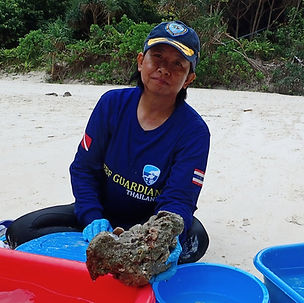
At Marine National Park Operation Center 3, leadership was never about authority—it was about presence. And Tim carried that presence with a quiet strength that never needed to announce itself. She was humble, grounded, and deeply human in the way she led—walking alongside her team rather than ahead of them, listening more than she spoke, and reminding everyone, simply by example, why their work mattered.
During the rehabilitation of Maya Bay, her influence could be felt in every corner of the operation. Not in grand gestures, but in the steady rhythm of a team that believed in what they were doing. She nurtured that belief. She kept spirits high when the work was hard, and purpose clear when challenges arose. Through her, the team did not just function, they stayed inspired.
Over time, what began as professional respect grew into something deeper. I came to see not only her dedication to conservation, but the sincerity of her character. There was no divide between who she was as a leader and who she was as a person. That rare consistency is what earned my respect and my friendship.
When her illness came, it did not define her. Even then, she carried herself with the same quiet grace. I visited her at home just days before she passed. There was no need for many words. Some connections go beyond conversation, they exist in shared understanding, in moments that linger without needing to be explained.
I was lucky to have known her, and even luckier to call her a friend.
Tim may no longer walk among the reefs she helped protect, but her spirit remains woven into the strength of the team she shaped, and the living recovery of the bay she cared for so deeply. Some people leave behind achievements. Others leave behind something far greater.
She will be remembered.
FRIENDSHIP THROUGH ETERNITY
INTERTIDAL CORALS

At Maya Bay, some of the most remarkable stories of resilience unfold in plain sight—along the shifting line where sea meets land. Here, we cultivate intertidal corals in an environment defined by extremes, where twice each month, during neap tides, the water recedes just enough to leave them exposed.
For a few hours, these corals endure what seems impossible. Under the weight of the tropical sun, with no water to surround them, they face heat, desiccation, and stillness. Yet they persist.
This is not by accident. Intertidal corals are shaped by adaptation and built to tolerate fluctuations that would stress or kill many other species. In this narrow band of the reef, survival demands flexibility, and over time, these corals have learned to endure cycles of exposure and submersion as part of their natural rhythm.
What we witness here is more than survival. It is proof that resilience already exists within the reef itself. Our role is not to impose strength, but to recognize it, support it, and allow it to express fully under the right conditions.
Twice a month, as the tide retreats and the corals are left momentarily bare, it may appear as vulnerability. But in truth, it is a quiet demonstration of endurance. One that reminds us that life on the reef is far more robust, and far more adaptable, than we often give it credit for.
Before the closure of Maya Bay, the damage was not limited to the reef. On land, vegetation had been steadily trampled under the weight of uncontrolled foot traffic. What should have been a thriving coastal forest was reduced in many areas to exposed, compacted ground stripped of its ability to regenerate.
Recovery began not with replanting alone, but with control and intention.
The introduction of new infrastructure clearly designated walkways and defined movement paths fundamentally changed how people interact with the landscape. Visitors are no longer free to wander indiscriminately. Instead, they are guided, allowing fragile vegetation the space it needs to recover naturally.
This shift may seem simple, but its impact is profound. By reducing physical pressure, the land is given back its capacity to heal. Roots take hold again, ground stabilizes, and the natural coastal system begins to reassemble itself.
It is a quiet but essential improvement. One that completes the broader initiative at Maya Bay—where conservation is no longer confined to the sea, but extends fully onto land.
Because true restoration does not stop at the shoreline.
On May 28, 2018, the world witnessed an unprecedented decision. Thailand closed the iconic Maya Bay. A destination immortalized by turquoise waters, towering limestone cliffs, and global tourism fame, in an act of desperation to save a dying reef ecosystem. What had once been celebrated as paradise had become a cautionary tale of ecological collapse. Beneath the postcard imagery, the corals were broken, the shallow reefs suffocated by sediment, blacktip reef sharks had disappeared from the bay, and decades of relentless tourism pressure had pushed one of the Andaman Sea’s most recognizable marine environments to the brink of irreversible destruction.
The closure of Maya Bay was widely reported across international media. Headlines spoke of overtourism, environmental degradation, and government intervention. Yet the true story of what happened after the gates closed - the struggle, the uncertainty, the scientific experimentation, the political pressure, the fieldwork beneath the surface, and the individuals who dedicated years of their lives to restoring the bay has never been fully told. Beyond the official announcements and polished narratives existed a far more complex reality: a race against time to understand whether a severely damaged reef system could biologically recover after decades of abuse.
This article chronicles the untold story of the Maya Bay rehabilitation project from its very beginning in 2018 until the reopening of the bay in 2022. It is not merely the story of a tourist destination being repaired, but the story of an ecosystem fighting for survival. The rehabilitation of Maya Bay became one of the most ambitious marine restoration efforts ever attempted in Southeast Asia, involving marine biologists, park authorities, conservationists, local communities, divers, volunteers and researchers working under immense public scrutiny.
As an advisor to the Marine National Park Operation Center 3 (Trang) I directly involved in the rehabilitation project, I witnessed firsthand the immense challenges faced beneath the surface. Challenges that were rarely visible to the public eye. Central to the restoration effort was the implementation of the coral propagation system I developed through Ocean Quest Global, an organic reef rehabilitation methodology specifically designed to restore coral ecosystems without relying on artificial reef structures. The Ocean Quest Global coral propagation system became the primary restoration framework utilized throughout the Maya Bay rehabilitation project, focusing on biological reef recovery processes rather than engineered replacements. Its application in Maya Bay would ultimately become one of the largest and most significant demonstrations of organic coral rehabilitation ever conducted in the region.
Among the most critical recommendations I submitted during the rehabilitation planning was the implementation of a “loop system” for visitor access, a management strategy that fundamentally changed how tourism would interact with Maya Bay. For decades, thousands of boats entered directly into the bay itself, generating constant propeller turbulence, wave pressure, anchor damage, fuel contamination, and sediment disruption across the fragile shallow reef ecosystem. My recommendation proposed that all visitors instead enter from the opposite side of the island, allowing Maya Bay to remain completely free from direct marine traffic. Under this system, tourists would disembark at a separate arrival point and traverse the island via a controlled pathway before arriving at the beach on foot. This effectively eliminated boat intrusion into the bay itself, drastically reducing one of the largest sources of ecological stress that had contributed to the reef’s collapse.
The adoption of this loop system became one of the defining management changes associated with Maya Bay’s reopening. More than a tourism redesign, it represented a philosophical shift in conservation strategy: the recognition that protecting coral reef ecosystems sometimes requires restructuring human behavior entirely, rather than attempting to engineer nature around tourism demands.
My involvement in Maya Bay was never driven by financial incentive. I was never paid for the work, recommendations, field contributions, or the implementation of the rehabilitation strategies I provided throughout the project. I participated because I believed Maya Bay deserved a chance to recover naturally after decades of exploitation. The reefs of Maya Bay were not simply tourism assets; they were living geological ecosystems that had evolved over thousands of years. Watching their collapse carried a responsibility to act. Every contribution I made — from coral propagation methodologies to ecosystem management recommendations — was done out of a deep commitment to coral reef conservation and the belief that if humanity caused the damage, humanity also carries the obligation to give nature the opportunity to heal.
Every stage of the recovery revealed difficult questions rarely discussed in mainstream conservation narratives: Can coral reefs truly recover once ecological balance collapses? What happens when tourism economies depend on the destruction of the very environment they market? And how do you rehabilitate a geological ecosystem that evolved over thousands of years?
The years between 2018 and 2022 transformed Maya Bay into a living laboratory of reef resilience. As tourist boats disappeared, nature began responding in unexpected ways. Sediments settled. Juvenile corals emerged across damaged reef flats. Blacktip reef sharks gradually returned to the shallow waters. But recovery was neither immediate nor linear. Storms, coral predation, bleaching stress, invasive impacts, and ongoing human pressures continued to challenge the fragile ecosystem. The rehabilitation demanded more than simply closing the beach; it required rethinking humanity’s relationship with coral reefs themselves.
This is the story behind the headlines, a story of ecological collapse, scientific discovery, political controversy, hope, and hard lessons for the future of marine conservation. Maya Bay became more than a destination. It became a global symbol of both the destructive power of uncontrolled tourism and the extraordinary resilience of nature when given a chance to heal.

VOLUNTEERISM
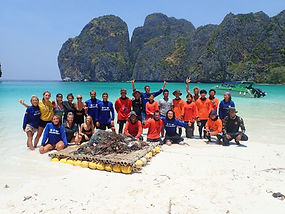
The rehabilitation project officially began accepting volunteers in October 2018, marking the start of what would become one of the largest community-driven coral reef rehabilitation initiatives ever conducted in Thailand. From that moment onward, more than 700 volunteers from all parts of the world would arrive at Maya Bay to become part of the recovery effort. They came from different countries, professions, cultures, and backgrounds, united by a common purpose, to help restore one of the world’s most damaged yet beloved marine ecosystems.
Every morning, volunteers would depart from Tonsai Pier in Ko Phi Phi Don and travel to Maya Bay before work commenced at 9 a.m. The daily operations often continued until 2 p.m. under intense tropical heat, shifting tides, and challenging sea conditions. Tasks ranged from coral propagation and reef monitoring to transporting equipment, maintaining restoration sites, documenting reef conditions, and assisting with countless logistical demands required to sustain the rehabilitation effort. Volunteers were generally not permitted to remain overnight at Maya Bay and would return to Phi Phi in the afternoon once the day’s operations concluded.
Yet the reality behind the project was often far more demanding than what visitors or volunteers witnessed during daylight hours. Certain team members were occasionally required to remain behind to complete additional work, secure equipment, monitor changing environmental conditions, or prepare for the next day’s operations. During the most difficult periods especially throughout the monsoon and wet season. Maya Bay could become isolated, battered by rough seas, torrential rain, and powerful winds sweeping through the limestone cliffs and exposed shoreline.
I was among those who remained through many of those difficult periods. In many ways, I quite literally lived in Maya Bay during the rehabilitation years. Long after the volunteers departed and the bay fell silent, work continued behind the scenes. The nights were often harsh, physically exhausting, and unpredictable, but they also revealed a side of Maya Bay few people have ever experienced. A place slowly reclaiming itself in the absence of mass tourism. During storms, rough tides, and prolonged isolation, the bay transformed from a tourist attraction back into a living ecosystem. It was during those moments, away from cameras and headlines, that the true rehabilitation of Maya Bay unfolded.
The volunteer program became more than a conservation initiative; it evolved into a global movement of individuals directly participating in the recovery of a coral reef ecosystem. Many arrived as tourists hoping to contribute for a few days, but left carrying a deeper understanding of the fragility of coral reefs and the immense effort required to protect them. The story of Maya Bay’s recovery was never built by one person alone. It was built through years of sacrifice, endurance, collaboration, and the shared belief that damaged ecosystems deserve the opportunity to heal.

FIRST SIGN OF LIFE
First Sign of Life
Four months into the rehabilitation of Maya Bay, we waited quietly, patiently for a sign that the reef was beginning to respond. Not a dramatic return, not the kind that makes headlines, but something small… something real.
And when it came, it was almost easy to miss. A few sea urchin and sea cucumbers.
No grandeur, no spectacle, just a dark, spiny silhouette moving slowly across the recovering substrate. Yet in that moment, it carried more meaning than any large predator ever could. It was the first signal that the system was beginning to breathe again. That the conditions were right. That life, in its own order, was returning.
Nature does not rush, nor does it skip steps. The sequence is ancient and precise. Before the reef can host abundance, it must first welcome the quiet workers. The grazers, the stabilizers, the ones that prepare the ground for everything that follows. The sea urchin was not just an arrival; it was a confirmation that the process was unfolding exactly as it should.
A month later, the sharks came. Their presence stirred excitement, as it always does. They are symbols of a healthy ocean, powerful and unmistakable. But by then, we understood something deeper. The true milestone had already passed.
Because long before the apex returns, life begins in silence. In the smallest, most unassuming forms. And if you learn to recognize those moments, you begin to see the reef not as something we rebuild, but something we patiently allow to heal.
The first sign of life is never about spectacle. It is about understanding.
MEDIA RUSH
When the sharks returned to Maya Bay, the ocean spoke quietly but the world answered loudly.
Headlines arrived in waves. Stories poured in from every direction, each one eager to capture the moment. To the outside world, it was a powerful symbol - the return of apex predators, a sign that the reef was alive again. But as the news spread, the narrative began to shift. Versions of the story multiplied, often told through distant voices. Some far removed from the work, others with little connection to the long, patient process that made it possible.
It became a storm of attention. Names, credit, and conclusions moved faster than truth. Yet beneath the surface, nothing had changed. The reef was still healing in its own time. The same hands continued their work, unseen. The same quiet milestones, like the first sea urchin months before and remained the true foundation of recovery.
The media saw the sharks. We saw the journey.
THE SILENCE OF ABSENCE
When COVID-19 swept across the world, it brought movement to a halt. Borders closed, boats disappeared, and places once defined by constant activity fell into an unfamiliar stillness. At Maya Bay and across many reef systems, the absence of people was immediate and absolute. What followed was not dramatic, but profound.
Without the daily pressure of tourism, anchors, and disturbance, the reefs were given something rare: uninterrupted time. Sediments settled. Water clarity improved. The constant stress that had long shaped these ecosystems simply… lifted.
It felt like a fast forward, but not because nature was rushing. Rather, it was finally allowed to move at its intended pace, free from interruption. Processes that are often masked by human presence became visible again. Recruitment, grazing, and natural succession unfolded with a clarity we seldom witness.
In Maya Bay, the quiet became part of the recovery. Not a solution in itself, but a condition that allowed everything else to work as it should. The pandemic reshaped the world in difficult ways. But beneath the surface, it revealed something essential. When pressure is removed, nature does not hesitate. It responds. And sometimes, the most powerful intervention… is simply stepping away.
MAYA TODAY
Maya Today
Today, Maya Bay stands not as a finished story, but as a living one. Still evolving, still finding its balance. The water moves as it always has, the reef continues its quiet work, and life returns not in sudden bursts, but in steady, deliberate rhythms.
What we see today is not a recovery defined by moments of attention, but by the accumulation of patience. Every small sign of life, every return, whether noticed or not is part of a much larger process that cannot be rushed or replicated.
Maya Bay is no longer just a place. It has become a reminder. A reminder that nature does not need to be rebuilt only understood. That true restoration lies not in intervention, but in restraint.
And that when given the chance, the ocean remembers how to heal.
The story continues.
TERRESTRIAL RECOVERY

KOH HAA & KOH ROK
A DECADE OF ECOLOGICAL TRANSFORMATION
KOH HAA
The Lagoon of Towers
KOH ROK - The Twin Island
Off the southwestern coast of Thailand, in the Andaman Sea, lie two of the region’s most pristine island groups: Koh Haa and Koh Rok. Both forming part of the protected waters of Mu Ko Lanta National Park. Their geography is defined by dramatic limestone formations, shallow reef systems, and clear oceanic conditions shaped by seasonal monsoons and strong tidal exchange.
Koh Haa literally “Five Islands” is a cluster of small karst islets rising abruptly from the sea. At its heart lies a semi-enclosed lagoon, protected by sheer limestone walls that create calm, shallow conditions and exceptional visibility. Submerged caves, swim-throughs, and vertical reef slopes define the underwater terrain, while patch reefs and sandy bottoms dominate the lagoon interior. The geomorphology here reflects classic Andaman karst erosion, where ancient limestone has been sculpted by both sea-level fluctuations and chemical weathering over millennia.


Koh Rok consists of two primary islands: Koh Rok Nai and Koh Rok Nok. The two islands is separated by a narrow channel. Unlike Koh Haa’s vertical drama, Koh Rok presents a broader, more horizontal landscape: long stretches of white sand beaches, gently sloping reef flats, and fringing coral gardens extending into deeper water. Inland, dense tropical forest covers much of the terrain, with limited freshwater sources. The reefs here are known for their accessibility and continuity, forming one of the most intact shallow reef systems in the southern Andaman region.
Governance and Protection
Both Koh Haa and Koh Rok fall under the jurisdiction of Mu Ko Lanta National Park, established in 1990 to safeguard the ecological integrity of the surrounding archipelago. As part of Thailand’s national park system, these islands are subject to regulated access, including daily visitor limits, designated mooring zones, and seasonal closures during the southwest monsoon.
The park authority enforces conservation measures aimed at minimizing reef damage. Anchoring is restricted to fixed buoys, fishing is prohibited within park boundaries, and ranger stations (particularly on Koh Rok) monitor visitor activity. Tourism is permitted but tightly managed, with most visitors arriving on day trips from Koh Lanta. Overnight stays are limited and controlled, ensuring minimal long-term human footprint.
In essence, Koh Haa and Koh Rok represent two distinct but complementary marine landscapes. One shaped by vertical karst complexity, the other by expansive reef flats. Both preserved under a governance framework that attempts to balance ecological protection with sustainable tourism in the Andaman Sea.

A Decade of Observation
This article presents a ten-year assessment (2016–2026) of coral reef dynamics at Koh Haa and Koh Rok within Lanta National Park, Thailand, based on biannual monitoring efforts, with an interruption from 2019 to 2022 due to the COVID-19 pandemic. The study captures two major thermal stress events; 2016 and 2024, that induced widespread coral bleaching and mortality, providing a rare longitudinal perspective on reef response to repeated climate-driven disturbances.
Findings reveal that reef resilience at these sites is not defined by a simple return to pre-disturbance conditions, but by adaptive transformation. Following the 2016 bleaching event, surviving coral communities exhibited regressive behaviours, including partial mortality and reduced growth, enabling persistence under prolonged stress. Concurrently, shifts in species composition favoured more thermally tolerant and opportunistic taxa, gradually restructuring the reef assemblage.
By 2023 and into early 2024, the reefs reached a functional peak, characterized by relatively stable coral cover, active recruitment, and improved structural complexity, albeit with a composition distinct from pre-2016 conditions. This recovery phase was abruptly disrupted by an acute thermal anomaly between May and June 2024, resulting in a second mass bleaching event that significantly altered the reef state. Post-bleaching observations indicate further regression among surviving colonies and an accelerated transition in species dominance.
By 2026, the reefs have entered a redefined equilibrium marked by altered community structure, modified physical complexity, and a distinct visual and ecological identity. The combined effects of regressive coral responses and species transitions have enabled continued ecosystem persistence despite repeated disturbances.
This study highlights the need to reconsider conventional definitions of reef resilience. Rather than recovery as a return to historical baselines, the reefs of Koh Haa and Koh Rok demonstrate resilience as the capacity for reorganization, adaptation, and persistence through ecological transformation in the face of escalating thermal stress.
Observation System and Methods
The observational system implemented at Koh Haa and Koh Rok is intentionally structured around the Depth Contour Grid approach to ensure that data collection aligns with the complex and heterogeneous nature of these reef environments. Unlike the conventional line intercept transect method, which assumes relatively uniform substrates and linear survey paths, these sites present irregular topography, steep gradients, and fragmented coral assemblages that cannot be accurately represented through straight-line sampling. By following natural depth contours, the Depth Contour Grid enables observers to capture ecological variability across distinct reef zones, improving both spatial representation and data reliability. This highlights a critical principle in coral reef science: the accuracy and usefulness of ecological data are fundamentally dependent on selecting methodologies that are appropriate to the physical and biological context of the study site. Using an unsuitable survey method not only risks underrepresenting key benthic communities but may also lead to flawed interpretations and ineffective conservation strategies, underscoring the necessity of methodological precision in reef monitoring and management.

Site Selection
The criteria for site selection are structured to capture a wide ecological gradient by incorporating differences in anthropogenic pressure, physical topography, and species distribution. Sites such as Koh Haa, which experience relatively higher levels of human activity from tourism, provide critical insight into reef responses under sustained disturbance, in contrast to Koh Rok where lower anthropogenic influence allows for observation of more natural or baseline reef conditions. This contrast enables a comparative framework to better understand stress tolerance, resilience, and recovery dynamics across sites. Additionally, the inclusion of varying depth ranges and seafloor terrains, ranging from shallow reef flats and sandy plateaus to deeper slopes and complex coral outcrops creates a diversity of underwater structures that support different biological assemblages. This heterogeneity not only enhances the scope of species observations but also allows for a more comprehensive assessment of ecological interactions, habitat utilization, and spatial distribution patterns across reef systems.
Ecological Trajectory
The ecological trajectory of the reefs at Koh Haa and Koh Rok from 2016 onward unfolds as a clear chronological progression of disturbance, response, and reorganization.
In 2016, a major thermal anomaly triggered widespread coral bleaching, resulting in significant mortality across both reef systems. Thermally sensitive taxa were disproportionately affected, leaving behind extensive areas of newly available substrate. This event marked the beginning of a new ecological phase, defined not only by loss, but by the conditions it created for subsequent recolonization.
By 2017, the reefs entered an early recovery stage characterized by the rapid rebound of pioneer species, particularly Acropora and Montipora. These fast-growing genera quickly colonized open spaces, exhibiting high recruitment rates and lateral expansion. Their presence contributed to a visible increase in live coral cover, signaling an initial rebound. However, this phase was driven by opportunistic growth rather than long-term stability, reflecting a classic early successional response.
Moving into 2018 and the years immediately following, shifts in species dominance began to emerge. At Koh Rok, shallow reef zones showed increasing prevalence of Porites rus, which gradually established dominance over previously recolonized areas. Its encrusting and submassive growth forms allowed it to consolidate substrate and persist under variable conditions, indicating a transition toward a more stress-tolerant community structure. At Koh Haa, a different pattern was observed: sandy plateau areas began to be reclaimed by Porites lobata. These sand-tolerant, massive colonies stabilized loose substrates and expanded into previously marginal habitats, effectively extending the functional footprint of the reef.
From 2019 to 2022, direct monitoring was interrupted due to the global pandemic. Despite this gap in field data, the period coincided with a marked reduction in anthropogenic pressures, including tourism and diving activities. When observations resumed, it became evident that the ecological trajectory had continued uninterrupted. Reef density had increased across multiple sites, with higher coral cover, improved colony cohesion, and reduced signs of physical disturbance. The ongoing interplay between pioneer taxa and increasingly dominant, stress-tolerant species contributed to a thickening and stabilization of reef structure.
By 2023 and into early 2024, the reefs reached a notable peak in development. Coral cover was relatively high, recruitment was active, and structural complexity had improved. Although the species composition differed from pre-2016 conditions, the reefs functioned as cohesive and productive systems. This phase represented the culmination of several years of ecological adjustment, where regressive survival strategies and species transitions had collectively reinforced reef resilience.
However, between May and the end of June 2024, an acute thermal spike once again elevated sea surface temperatures beyond critical thresholds, triggering a second mass bleaching event. The impact was immediate and severe, affecting corals across both Koh Haa and Koh Rok. Many colonies exhibited regressive responses partial mortality, tissue contraction, and fragmentation while others were lost entirely. This event disrupted the trajectory that had been building toward peak reef density and stability.
From late 2024 through 2025 and into 2026, the reefs entered a new phase of reorganization. The post-bleaching environment favored highly tolerant and opportunistic species, accelerating shifts in community composition. Structural complexity, though altered, began to re-emerge through different assemblages and growth forms. The reefs no longer resembled their pre-2016 state, nor their 2023 peak, but instead reflected a redefined equilibrium shaped by repeated disturbance and adaptive response.
Over this ten-year period, the reefs of Koh Haa and Koh Rok demonstrate a continuous, evolving ecological trajectory. Beginning with disturbance in 2016, followed by pioneer recolonization, species reorganization, increased density during reduced human pressure, a peak in 2023, and a transformative bleaching event in 2024, the system has persistently adapted. This chronology highlights that reef resilience is not a linear recovery, but an ongoing process of change, where survival is achieved through flexibility, transition, and reassembly.