
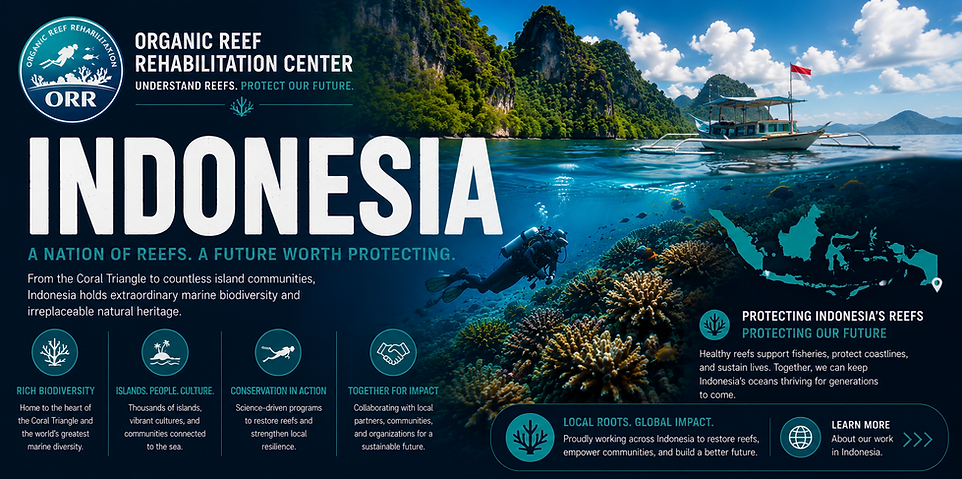
The Indonesia is the world’s largest archipelago, consisting of more than 17,000 islands spread across the equator between the Indian and Pacific Oceans. Positioned at the heart of the Coral Triangle, Indonesia possesses some of the richest marine biodiversity on Earth, with vast coral reef systems, volcanic islands, mangrove forests, deep channels, and highly productive marine ecosystems. Its waters are home to legendary diving destinations such as Raja Ampat, Komodo, Banda Sea, Wakatobi, and Bali, attracting divers, researchers, and conservationists from around the globe. Indonesia’s immense marine diversity and ecological significance make it one of the most important regions for coral reef research, marine conservation, underwater exploration, and sustainable ocean stewardship within the Indo-Pacific.
Sulawesi — The Heart of the Coral Triangle
Sulawesi is one of the most extraordinary marine regions on Earth, situated at the center of the legendary Coral Triangle — the global epicenter of coral reef biodiversity. This vast Indonesian island, shaped like an intricate orchid with long peninsulas extending into deep tropical seas, lies where powerful oceanic currents from the Pacific and Indian Oceans converge. Over millions of years, these currents, combined with volcanic geology and tectonic activity, created ideal conditions for the evolution of modern coral ecosystems. Scientists recognize the region as one of the most biologically productive marine environments in existence, containing the highest concentration of reef-building coral species and reef fish diversity anywhere in the world.


The seas surrounding Sulawesi are home to immense coral walls, seagrass meadows, mangrove forests, deep pelagic channels, volcanic islands, and nutrient-rich upwelling systems. These habitats support thousands of marine species including reef sharks, manta rays, turtles, dugongs, pygmy seahorses, nudibranchs, whale sharks, and countless endemic reef organisms. The northern tip of Sulawesi has been identified as one of the highest marine biodiversity hotspots within the Coral Triangle itself.
Among Sulawesi’s most celebrated marine destinations are the Togian Islands and Wakatobi National Park. The Togian Islands, hidden within the calm waters of the Gulf of Tomini, are an isolated archipelago of rainforest-covered islands surrounded by pristine reefs and crystal-clear lagoons. The islands form part of the Coral Triangle and host hundreds of coral and reef fish species, including endemic wildlife and rare marine habitats.
Further southeast lies Wakatobi, regarded by many marine scientists and divers as one of the finest reef systems in the Indo-Pacific. Wakatobi National Park encompasses vast coral reef systems, atolls, barrier reefs, and steep underwater walls with exceptional coral density and clarity. Surveys have recorded hundreds of coral species and nearly a thousand reef fish species within its waters, making it one of the richest reef ecosystems in the world.


Gateway Cities to Sulawesi
The main international and domestic gateways into Sulawesi include:
-
Makassar — the primary transportation hub of Sulawesi with extensive domestic and international connections.
-
Manado — gateway to Bunaken and northern Sulawesi dive regions.
-
Kendari — the main access point to Wakatobi.
-
Palu — access point for central Sulawesi expeditions.
-
Gorontalo — commonly used for access to the Togian Islands.
Most international travelers arrive via Jakarta, Bali, or Singapore before taking domestic flights into Sulawesi.
How to Reach the Togian Islands
Access to the Togian Islands typically involves a combination of flights, land transport, and ferries.

Common Route
-
Fly to Palu, Luwuk, or Gorontalo.
-
Travel by road to the coastal port town of Ampana or depart from Gorontalo Harbor.
-
Continue by public ferry or speedboat into the islands.
Local Transportation
-
Public ferries connect major islands several times weekly.
-
Private speedboats are widely used for dive operations and island transfers.
-
Small wooden boats operated by local Bajau communities are common between villages and reefs.
-
Motorbikes are the primary transportation on inhabited islands.
How to Reach Wakatobi
The most efficient route to Wakatobi is through Kendari.
Common Route
-
Fly domestically to Kendari from Jakarta, Bali, or Makassar.
-
Continue with a regional flight to Wangi-Wangi Island.
-
Resorts and dive operators usually arrange boat transfers to surrounding islands and dive sites. (EnPress)
Local Transportation
-
Inter-island ferries connect Wangi-Wangi, Kaledupa, Tomia, and Binongko.
-
Small passenger boats and dive boats are the main mode of marine transportation.
-
Motorbike taxis and minibuses operate on the larger islands.
-
Many remote eco-resorts provide private boat transfers directly from airports or harbors.
Sulawesi remains one of the last great frontiers of marine exploration. A place where ancient geological processes, oceanic circulation, and biological evolution converged to create the modern architecture of coral reef ecosystems. For divers, marine researchers, and conservationists alike, Sulawesi is not simply a destination; it is a living laboratory of the tropical oceans and one of the most important reef systems on the planet.

TOGIAN
The Togian Islands, located in the calm waters of the Gulf of Tomini in Central Sulawesi, are among the most pristine and biologically rich marine ecosystems within the Coral Triangle, the global epicenter of coral reef biodiversity. This remote Indonesian archipelago is renowned for its spectacular coral reefs, crystal-clear lagoons, mangrove forests, and extraordinary abundance of marine life including reef sharks, turtles, pygmy seahorses, giant clams, and countless reef fish species. Surrounded by volcanic islands and traditional Bajau sea villages, the Togians offer a rare combination of untouched natural beauty, rich maritime culture, and exceptional diving opportunities, making them one of Southeast Asia’s hidden treasures for marine exploration, conservation, and underwater adventure.

MY MISSION
My mission across the Togian is Education and Exploration. The coral reef ecosystem in this region are generally healthy and they are best left to thrive without interventions. However, the people must understand the fragility of the environment they lived in.

MY MISSION
My mission in Una Una is Education and Exploration. The coral reef ecosystem at this location are generally healthy and they are best left to thrive without interventions. My exploration here reveals the way coral reefs evolves and the transition of species. The understanding of the living and dying cycles that formed the substructures of reefs.
Una Una is a remote volcanic island located within the Togian Archipelago of Central Sulawesi, Indonesia, rising dramatically from the deep waters of the Gulf of Tomini at the heart of the Coral Triangle, the global epicenter of marine biodiversity. Formed through ancient volcanic activity, the island is dominated by the towering Colo Volcano, whose eruptions over geological time helped shape the surrounding marine landscape and create nutrient-rich conditions for coral development. Encircling the island are remarkably pristine coral reef systems regarded among the oldest surviving reef formations in the Indo-Pacific, evolving over millions of years through continuous biological and geological processes. These reefs support extraordinary marine biodiversity, including dense hard coral colonies, massive sponge gardens, reef sharks, turtles, barracudas, pygmy seahorses, and vast schools of tropical reef fish. Steep volcanic drop-offs, underwater pinnacles, and clear oceanic waters make Una Una one of Sulawesi’s most spectacular and ecologically important marine environments. Isolated from large-scale coastal development and mass tourism, the island remains a rare example of a relatively intact tropical reef ecosystem where volcanic geology, oceanic circulation, and ancient coral evolution converge in one of the world’s last great underwater frontiers.
Una Una
Sanctum Una Una Eco Dive Resort

Located on the remote volcanic island of Una Una in the heart of the Togian Archipelago, Sanctum Una Una Eco Dive Resort is one of the premier eco-diving destinations within Indonesia’s Coral Triangle. Surrounded by pristine reefs, dramatic underwater pinnacles, volcanic slopes, and nutrient-rich waters of the Gulf of Tomini, the resort offers direct access to some of the most biodiverse marine ecosystems in Southeast Asia. Designed around sustainable island living, the resort combines eco-conscious operations with comfortable beachfront accommodations, locally inspired hospitality, and professional dive facilities. Divers can explore vibrant coral gardens, walls, muck sites, and pelagic-rich waters inhabited by reef sharks, barracudas, turtles, Napoleon wrasse, frogfish, and vast schools of reef fish, often only minutes from the resort itself. Positioned far from mass tourism, Sanctum Una Una provides an immersive experience where marine exploration, conservation awareness, and authentic island culture converge in one of Sulawesi’s last great underwater frontiers.

The Coral Expedition
My work in Una Una focuses on marine exploration, coral reef assessment, ecological documentation, and the promotion of organic reef rehabilitation within one of the Coral Triangle’s most pristine marine environments. A major component of the research investigates the evolutionary processes of species transition during reef development. The constant volcanic tremors generated by Colo Volcano naturally fragment coral structures, creating conditions that appear to accelerate reef succession by “fast-forwarding” transitional reef zones into increasingly established ecosystems. This unique interaction between volcanic geology and coral biology provides a rare natural laboratory for studying reef formation, adaptation, colonization, and long-term ecological resilience. Our 2024 Coral Expedition formed an important part of this ongoing discovery, contributing valuable field observations and ecological documentation toward understanding how volcanic activity influences coral evolution and reef ecosystem development. Through these efforts, the project highlights the ecological significance of Una Una while supporting conservation awareness and sustainable protection of its extraordinary marine biodiversity.
Paradise Shaped By Fire
Una Una is a world shaped by fire beneath the sea. Rising from the deep waters of the Gulf of Tomini, this remote volcanic island is surrounded by more than forty world-class dive sites, each carrying its own character, mystery, and living architecture. Along the shallow reef flats, sunlight dances across endless coral gardens where juvenile fish seek shelter among branching colonies that have endured generations of volcanic tremors. Beyond the shallows, the reefs suddenly descend into immense walls draped with giant sponges, soft corals, and swirling schools of fusiliers that move like rivers of silver through the blue. Further offshore, hidden subterranean pinnacles rise from the depths like ancient underwater mountains, attracting barracudas, reef sharks, tuna, and pelagic life carried by the nutrient-rich currents surrounding the island.
What makes Una Una extraordinary is not merely the abundance of life, but the harmony in which life exists here. Every reef appears connected through an intricate balance shaped over millennia by volcanic activity, oceanic circulation, and biological succession. Corals broken naturally by tremors do not signify destruction, but renewal. Fragments becoming foundations for new colonies, transitional reefs evolving into mature ecosystems with remarkable speed. In these waters, one witnesses not only the beauty of coral reefs, but the very process of reef evolution itself.


Diving in Una Una feels less like entering the ocean and more like stepping into a living chronicle of Earth’s marine history. Each site reveals another chapter: pristine hard coral plateaus, towering volcanic ridges, dark crevices alive with cryptic species, and open blue channels where pelagic predators patrol ancient migratory paths. The reefs breathe with movement and purpose, reminding us that healthy ecosystems are not static structures, but dynamic worlds constantly shaped by disturbance, recovery, adaptation, and coexistence.
Our expeditions here have become journeys of both exploration and understanding. Beneath the surface of Una Una lies one of the rarest opportunities in the modern world - the chance to observe how life rebuilds itself in harmony with geological forces. It is a place where coral reefs are not merely surviving, but continuously becoming.


The Black Forest
There are places where the sea feels young, restless, unfinished, still shaping itself. And then there is the Black Forest of Una Una, where time settles into something deeper, older, almost immovable. Beneath the surface, rising from the dim blue like the pillars of a submerged cathedral, stand the great colonies of Porites rus. These are not simply corals; they are living monuments. Layer upon layer, year upon year, century upon century, they have built themselves upward from the depths. A slow architecture sculpted by light, current, and patience. In the quiet rhythm of neap tides, their uppermost forms breach the surface, as if the reef itself is breathing, touching air before returning to the sea.
To dive here is to descend through time. There is no spectacle manufactured for attention, no dramatic chase, no fleeting distraction. The Black Forest asks something else of you: stillness. Presence. A willingness to witness scale not in size alone, but in duration. Every ridge, every contour of these towering Porites structures holds a memory of seas long past, of temperatures that rose and fell, of storms endured, of life that came, settled, and moved on. This is why divers return. Not for variety, but for truth. And that truth begins far beyond the reef itself.
To understand the Black Forest, you have to look up toward the looming presence of Mount Colo. Una Una is no ordinary island. It is the exposed summit of a submarine volcano, a solitary giant rising from the depths of Gulf of Tomini. When Mount Colo erupted, most notably in 1983 it reshaped not only the land above sea level, but the unseen contours below. Lava and ash poured into the surrounding waters, resetting sections of the reef, creating new substrates, new beginnings. Where destruction seemed absolute, time quietly began again.
The Gulf of Tomini itself is a geological paradox. Nestled at the heart of the Coral Triangle, it is one of the largest gulfs in Indonesia, yet unusually enclosed. Its waters deep, calm, and ancient. Unlike open ocean systems constantly reshaped by strong currents, Tomini holds its history close. Sediments settle slowly. Conditions stabilize. And in that stability, reefs are given something rare: the uninterrupted luxury of time. It is within this cradle that the Black Forest grew.
While other reefs are broken, scattered, or grazed down by disturbances both natural and human, this site endured in relative isolation. The massive Porites colonies, resilient by nature, slow to grow but slower to die found here the perfect balance: enough nutrients, enough light, and above all, enough continuity. Over centuries, they rose. Not in chaotic competition, but in quiet dominance, forming dense, towering structures that now define the reef’s identity.
Divers who enter this space often struggle to describe it. The scale feels wrong at first. Too large, too solid, too permanent for something we are used to thinking of as fragile. Schools of fish move like drifting shadows against coral walls that seem carved rather than grown. Light filters down in long, deliberate beams, tracing contours that have not meaningfully changed in generations. And in that moment, a realization settles in: This is what a reef looks like when it is allowed to become itself.
The Black Forest is not just a dive site. It is a convergence of forces. Volcanic fire and oceanic stillness, destruction and patience, geology and biology woven into a single, living system. Mount Colo built the foundation through upheaval. The Gulf of Tomini protected it through time. And the corals are silent, tireless. And did the rest. There are no other reasons to dive here. Because once you have seen a reef that has truly lived, measured not in years, but in centuries you begin to understand how rare such places are. And how much of the ocean’s story has already been lost before we ever thought to listen.

MY MISSION
My mission in Bahia Tomini is Education and Exploration. The coral reef ecosystem at this location are generally healthy and they are best left to thrive without interventions. I have taught a coral propagation and coral nursery development course here. This allowed them to aid the growth of corals in damaged areas of their reef.

BAHIA TOMINI ECO RESORT
Nestled along the quiet shores of Tomini Bay, Bahia Tomini Eco Resort is a small family-like sanctuary built upon a deep respect for nature and the surrounding marine environment. Far from the noise of mass tourism, the resort embodies a simple yet meaningful philosophy that true hospitality is not only about caring for guests, but also about protecting the ecosystems that sustain the community and the sea. Despite its modest size, Bahia Tomini Eco Resort carries a profound commitment to environmental stewardship, supporting conservation efforts while offering visitors an intimate connection to one of Indonesia’s most pristine coastal frontiers.
ORR recognizes that meaningful conservation is not measured by the size of an organization, but by the sincerity of its conscience and the persistence of its actions. Bahia Tomini Eco Resort stands as a reminder that small, dedicated efforts, when driven by genuine care for the environment, collectively possess the power to shape a better world. Through consistency, humility, and unwavering commitment, they demonstrate that true conservation begins with people who choose to protect what they love, regardless of scale or recognition.


Crystal clear waters and high diversity coral reefs are the signature of Togian Islands. Acorpora togeanensis (right) is a species named for this region.
Underwater Realms
There are places where diving feels like a pastime—and then there are places where it feels like a privilege. Bahia Tomini belongs firmly to the latter. Tucked quietly within the wild expanse of the Togian Archipelago, Bahia Tomini is not built for crowds, nor for spectacle. Its small, dedicated dive outfit reflects something far more intentional: access without excess. Here, every departure is unhurried, every site chosen with care, every descent a deliberate step into one of Southeast Asia’s most intact marine landscapes.
The reefs that fringe these islands are nothing short of extraordinary. Born at the crossroads of powerful currents and ancient seas, they host a density and diversity of life that defies expectation. Vast coral gardens stretch into the blue, uninterrupted and thriving. Walls plunge into shadow where pelagic roam. Reef flats shimmer with intricate ecosystems that reveal themselves only to those who slow down enough to truly see. This is not curated diving. It is raw, living ocean in its most honest form.
What sets Bahia Tomini apart is not just where it is, but how it allows you to experience it. The scale remains intimate. The encounters feel personal. There is space to absorb the silence between breaths, to notice the subtle interplay of species, to reconnect with the rhythm of the sea rather than rush through it.
In the Togian Islands, the ocean still leads and Bahia Tomini simply opens the door.
For those who understand that the finest diving in the world is not defined by luxury, but by authenticity, this is where you arrive not just to explore, but to remember why you started.

EAST KALIMANTAN
At the farthest reach of Borneo’s eastern coastline, where the land narrows into a quiet, wind-shaped “nose” facing the open sea, lies the unassuming settlement of Biduk-Biduk. It is a place that feels suspended between worlds. Where dense tropical forest exhales into salt air, and the rhythms of the ocean quietly dictate the pace of life. Here, simplicity is not an absence, but a presence: wooden homes on sandy stretches, fishermen reading tides like inherited memory, and horizons that seem to stretch without end.
This is also the ancestral land of the Dayak once feared and misunderstood as headhunters, yet in truth deeply rooted custodians of the forest, carrying generations of knowledge, ritual, and connection to the land. Their legacy lingers quietly in the spirit of the place, woven into the stories, the landscapes, and the enduring relationship between people and nature.
Though small and often overlooked, Biduk-Biduk is a gateway to some of Borneo’s most pristine coastal ecosystems, where coral reefs, seagrass beds, and hidden lagoons whisper stories of a natural world still largely intact. It is not a destination that announces itself loudly, but one that reveals its depth slowly to those willing to arrive with patience, curiosity, and respect.
MY MISSION
My mission in East Kalimantan is Exploration. It is one of the remotest location of my journeys. Through this exploration I uncover the untouched reefs with pristine corals. But it does not come without human pressures. Away from law and enforcements, this location is one of the most heavily bombed and poisoned in the whole of Coral Triangle. Coral bleaching here does not come from the climate, it came from the extensive use of cyanide for fishing. This exploration uncovers the exploitation of our very last frontiers. This exploration also uncovers how indigenous cultures coexisted in parallel with nature without written boundaries.
The Dayak of Borneo: Culture, Memory, and a Forest in Retreat
The Dayak are not a single tribe but a constellation of indigenous peoples spread across the vast interior of Borneo. From the highland Kenyah and Kayan to the riverine Iban and the forest-dwelling Punan. What binds them is not uniformity, but a shared philosophy: life is inseparable from the forest. For generations, the jungle has been their larder, their pharmacy, their cathedral, and their archive of knowledge. Rivers are their highways, and the longhouse, often stretching like a living spine along the riverbank is more than architecture; it is a social organism where entire communities live, celebrate, and resolve life together.

Dayak culture is rich with symbolism and spiritual depth. Traditional tattoos map a person’s journey through life. Each motif marking protection, achievement, or passage. The hornbill, often seen in elaborate headdresses, represents the bridge between the earthly and the spiritual realms. Rituals once included headhunting, a practice widely misunderstood outside the region. Within its historical context, it was tied to warfare, protection, and cosmology rather than savagery. Today, it survives only in memory and ceremonial storytelling, a reminder of a time when identity and survival were fiercely defended.
Yet the most defining element of Dayak life the rainforest is rapidly shrinking. Borneo’s jungles, among the oldest on Earth, have been cleared at an alarming rate over recent decades, largely driven by logging and the expansion of palm oil plantations. Where once stood towering dipterocarp forests now lie grids of monoculture, silent and uniform. For the Dayak, this is not just environmental loss; it is cultural erosion. When the forest disappears, so too do the plants used in medicine, the animals woven into folklore, and the sacred sites tied to ancestral spirits.
Despite these pressures, the Dayak are not passive witnesses to change. Across Borneo, communities are asserting land rights, reviving traditional ecological practices, and partnering with conservation efforts to protect what remains. There is a quiet resilience here, a determination to adapt without severing the deep-rooted connection to land and identity. To understand the Dayak is to understand that their story is not only about a people, but about a living ecosystem under strain. Their future, like the forest itself, hangs in a delicate balance between preservation and loss, memory and modernity.
REEF EXPLORATION
In the waters off East Kalimantan, I encountered a contradiction that reshaped my understanding of reefs: I had long believed that distance from human activity guaranteed pristine ecosystems, yet here I found two opposing realities, reefs so untouched they felt like living cathedrals of coral, vibrant and beyond description, and others reduced to silent rubble, devastated by lawlessness, exploitation, and unchecked greed; what separated them was not remoteness, but presence, as the most intact reefs were often those closest to indigenous communities such as the Dayak, whose generations-long relationship with the sea created an unspoken protection, a boundary enforced not by law but by belonging, watchfulness, and respect, while the most damaged reefs lay in places absent of this connection. Unclaimed, unguarded, and exposed to outsiders who take without consequence, revealing a deeper truth that conservation is not about removing people, but about the presence of the right people, because in Borneo, it is not distance that saves a reef, but the strength of the relationship between community and ocean.
The Dayak and the Bajau

Along the coasts of East Kalimantan, the story of the reefs is not simply one of exploitation and protection, but of two indigenous worlds moving in parallel. The forest-rooted Dayak and the sea-bound Bajau; the Bajau, long regarded as nomads of the ocean, possess an intimate knowledge of reefs and tides, yet in these waters their presence reveals a harder truth, as some reef exploitation traces back not to distant outsiders but to another indigenous system shaped by survival at sea, and still, an unspoken boundary persists, where Bajau fishers rarely encroach into Dayak territories, leaving pockets of reef near these forest communities remarkably intact; it is a fragile equilibrium. Two cultures, two relationships with nature, coexisting for centuries not through formal governance but through respect, distance, and an inherited understanding of where one world ends and another begins.
The exploration revealed far more than the biology and evolutionary story of the reefs; it uncovered a living demography of the people who share these waters. Where communities like the Dayak and the Bajau exist within distinct yet overlapping worlds, each shaped by a deep, inherited relationship with land and sea; their coexistence is not accidental but defined by quiet ecological boundaries. Unwritten, respected, and rarely crossed. Where stewardship, survival, and cultural identity align to create pockets of resilience in both forest and reef; in these spaces, human presence does not diminish nature but reinforces it, revealing a powerful truth that ecosystems can thrive not in the absence of people, but through balance, restraint, and a shared understanding of where to belong.
Labuan Cermin
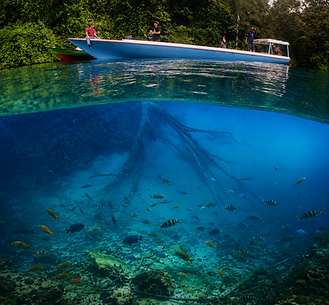
Tucked within the coastal landscape of Biduk-Biduk, Labuan Cermin stands as a quiet anomaly, a meromictic body of water where two worlds exist in perfect stillness. Its surface, fed by freshwater, is so clear it mirrors the sky with glass-like precision, while just beneath lies a denser layer of saltwater that never truly mixes, separated by a delicate, invisible boundary. Here, you can float effortlessly at the surface and, with a single dive, pass through a shimmering threshold into a different chemical realm. Fresh above, saline below, an experience that feels almost unreal. This natural stratification gives Labuan Cermin its name, “Mirror Lake,” but it is more than a visual marvel; it is a living system of balance and separation, where time, water, and geology have conspired to create one of the most unique aquatic environments in Borneo.
Lamin Guntur
Hidden within the forests of East Kalimantan, Lamin Guntur stands as a living expression of Dayak heritage. An elongated wooden longhouse raised on stilts, where architecture and community are inseparable. More than a dwelling, it is a social spine that holds generations under one roof, where stories, rituals, and daily life unfold in a shared rhythm. Carved motifs and painted forms speak of ancestral beliefs, spirits of the forest, and a worldview deeply tied to nature. In a landscape where the jungle is steadily retreating, Lamin Guntur remains not just a cultural landmark, but a quiet assertion of identity rooted, enduring, and still connected to the land that shaped it. Miles away from nearest settlement and in the heart of the Dayak ancestral land, Lamin Guntur sits in a coconut grove fronting a golden beach.


Planned Return Expedition
Reaching Lamin Guntur is an expedition in itself. Nine relentless hours cutting through the depths of Borneo along unforgiving logging roads, where mud, ruts, and dense forest test both machine and resolve. The journey stretches through a landscape that feels endless, the jungle closing in on all sides, reminding you how small you are within it. Our team moved in 4x4 vehicles, loaded with food, diving gear, and the weight of purpose, departing from Balikpapan and pushing eastward through the remote village of Biduk-Biduk before turning inland. It is a passage that strips away convenience and replaces it with effort, Each kilometer earned, transforming the journey into a combination of off-road endurance, underwater exploration, and a survival expedition in its own right, so that by the time Lamin Guntur emerges from the forest, it feels less like a destination and more like a place you have been allowed to reach. The expedition is set to return in January 2029, not just to retrace the route, but to continue the story of reefs, forests, and the fragile balance that binds them together.