

The publications featured here form the backbone of the ORR learning experience, practical, field-tested knowledge distilled into manuals and books designed to guide real-world reef rehabilitation. These are not passive readings, but working documents used actively within our training programs, where each concept is applied, questioned, and refined in the water. Because the ORR education system is built to be comprehensive, these materials serve as essential tools in developing both understanding and skill-bridging ecological theory with hands-on conservation. Together, they represent a living body of knowledge, shaped by experience and intended to equip the next generation of reef stewards with the clarity and competence to restore coral ecosystems responsibly.

Coral Biology (New Book)
Coral Biology is a comprehensive guide to understanding the remarkable organisms that build and sustain the world's coral reef ecosystems. Covering coral anatomy, physiology, reproduction, ecology, symbiosis, growth, adaptation, and environmental interactions, this book provides a clear and scientifically grounded exploration of how corals function as living architects of the ocean. Drawing from field experience, contemporary research, and practical conservation perspectives, it bridges the gap between marine science and reef stewardship, making complex biological concepts accessible to students, divers, conservation practitioners, and ocean enthusiasts. More than a study of corals, this book reveals the intricate relationships that underpin reef resilience and highlights the critical role of coral biology in the future of marine conservation.

Revised Edition
This revised edition of Complete Guide to Coral Reef Rehabilitation represents a major advancement in reef restoration philosophy and practice. Drawing upon years of field experience, scientific refinement, and practical implementation, it places natural ecological processes, biodiversity, and long-term resilience at the heart of rehabilitation efforts. More than an update, this edition redefines the framework of organic reef rehabilitation by clarifying misconceptions, strengthening scientific foundations, and providing a more disciplined and ecologically responsible approach for practitioners, divers, and conservationists. As the definitive replacement for previous editions, it reflects current standards and the realities of modern reef conservation. Ultimately, this book is not only about restoring coral reefs—it is about transforming the way we understand, value, and interact with the ecosystems we seek to protect.
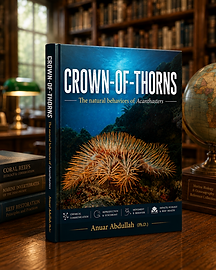
The Work on This Book
This book is the result of thirty years of observation, research, and field documentation of the Crown-of-Thorns Starfish (Acanthaster) from 1995 to 2025. Driven by a simple question, why do many healthy coral reefs continue to thrive alongside natural populations of Acanthaster despite the absence of human intervention? This work explores the biology, anatomy, physiology, reproduction, behavior, ecological functions, and global distribution of all known Crown-of-Thorns species. Drawing upon decades of underwater observations across managed and unmanaged reef ecosystems, it challenges conventional perceptions that portray these starfish solely as destructive coral predators and instead examines their role as native participants in reef ecology. By combining long-term field observations with modern scientific discoveries in genetics and marine ecology, this book offers a comprehensive perspective on one of the most controversial species on coral reefs and invites readers to reconsider the relationship between natural ecological processes, conservation, and reef resilience.

The Conservation Enterprise
Blue Economy Strategies
The Conservation Enterprise: Blue Economy Strategies is a practical guide for entrepreneurs, conservation organizations, social enterprises, and community leaders seeking to build resilient businesses that create both economic and environmental value. Drawing on real-world experience, the book demonstrates how Blue Economy principles can transform conservation from a cost into a sustainable enterprise by integrating ecological restoration, community participation, innovation, and financial viability. It provides strategic frameworks, practical models, and field-tested approaches for developing enterprises that generate long-term economic growth while restoring natural capital, empowering communities, and creating measurable environmental impact.