

_svg.png)
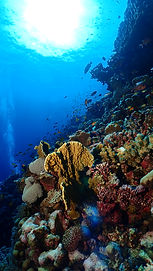
The Red Sea, including the renowned reefs of Safaga, Marsa Sharga, Hurghada, Sharm El Sheikh, and the Gulf of Aqaba, represents one of the world’s most remarkable marine ecosystems. Shaped by millions of years of evolutionary isolation and environmental change, the corals of the Red Sea have developed extraordinary resilience to high temperatures and salinity, making them increasingly important in the study of coral survival in a warming world. From vibrant coral gardens to dramatic reef walls, these ecosystems stand as living evidence of nature’s adaptability, endurance, and the urgent need to protect one of the planet’s most resilient coral reef systems.

MARSA SHARGA
Situated along the remote southern coastline of the Red Sea, Marsa Shagra Village and Red Sea Diving Safari have long been recognized as pioneers of sustainable dive tourism and guardians of Egypt’s pristine reef ecosystems. Built upon a philosophy of simplicity, environmental respect, and immersive ocean experiences, Marsa Shagra offers divers direct access to some of the Red Sea’s most vibrant coral reefs, where marine life continues to thrive in remarkable abundance. Through responsible diving practices and a deep connection to the surrounding environment, Red Sea Diving Safari has created more than a destination. It has cultivated a community united by a shared appreciation for the sea and the importance of protecting one of the world’s most resilient coral reef systems.




RED SEA EXPEDITIONS
Each November, as the seasons shift and the Red Sea settles into clarity and calm, Ocean Quest France sets out on an expedition that is as much about understanding as it is about exploration. This is not a typical dive holiday. It is a two-week immersion into one of the most resilient marine ecosystems on Earth. An experience designed for those who want to see more, learn more, and ultimately, care more. The journey unfolds in two distinct chapters: a week aboard a liveaboard vessel, tracing remote reefs and open water systems, followed by a week on shore, where time slows and observation deepens.
In 2025, the expedition ventured south to Marsa Shagra, where raw reefscapes and minimal human pressure offered a powerful glimpse into the Red Sea’s natural state. In 2026, the journey begins from Hurghada, extending into the dynamic reef systems of Safaga and the outer reefs. Regions shaped by currents, isolation, and extraordinary biodiversity.
Throughout the expedition, divers are not just observers, but participants in a deeper narrative. Educational sessions bring the underwater world into focus—unpacking reef ecology, species interactions, and the evolutionary resilience that defines the Red Sea. Photography and filming become tools of storytelling, encouraging divers to document, interpret, and share what they witness beneath the surface.
What makes this expedition truly compelling is its intent. It bridges adventure with awareness, transforming each dive into a lesson, each encounter into insight. You return not only with images and memories, but with a refined understanding of the ocean’s complexity and your place within it.
For those drawn to the sea not just for its beauty, but for its meaning, this is where exploration becomes education, and diving becomes purpose.


SHARM EL SHEIK
Perched at the southern tip of the Sinai Peninsula, Sharm El Sheikh is one of the Red Sea’s most iconic coastal destinations, where desert landscapes meet some of the world’s most vibrant coral ecosystems. Fringed by the protected waters of Ras Mohammed National Park and the straits of Tiran Island, it offers exceptional diving and snorkeling defined by clear visibility, dramatic drop-offs, and thriving reef biodiversity. Beyond the water, Sharm blends resort luxury with stark, beautiful desert terrain, making it a gateway to both marine exploration and the rugged heart of the Sinai.

RAS MUHAMMAD NATIONAL PARK
Ras Muhammad National Park, located at the southern tip of Egypt’s Sinai Peninsula near Sharm El Sheikh, is one of the world’s most renowned marine protected areas and a benchmark for coral reef conservation. Established in 1983, the park protects an extraordinary diversity of marine life, including over 220 coral species and more than 1,000 fish species, thriving within the nutrient-rich waters where the Gulf of Aqaba and the Gulf of Suez converge. Its spectacular reef systems, such as Shark Reef and Yolanda Reef, are celebrated for their exceptional coral cover, abundant pelagic fish, and remarkable ecological integrity. Beyond its underwater treasures, the park encompasses mangrove forests, salt marshes, and desert landscapes that support migratory birds and other wildlife. Ras Muhammad is widely regarded as a conservation success story, demonstrating how effective protection of ecological processes and habitats can maintain reef resilience and biodiversity, making it an invaluable natural laboratory for marine scientists, conservationists, and coral reef rehabilitation practitioners worldwide.